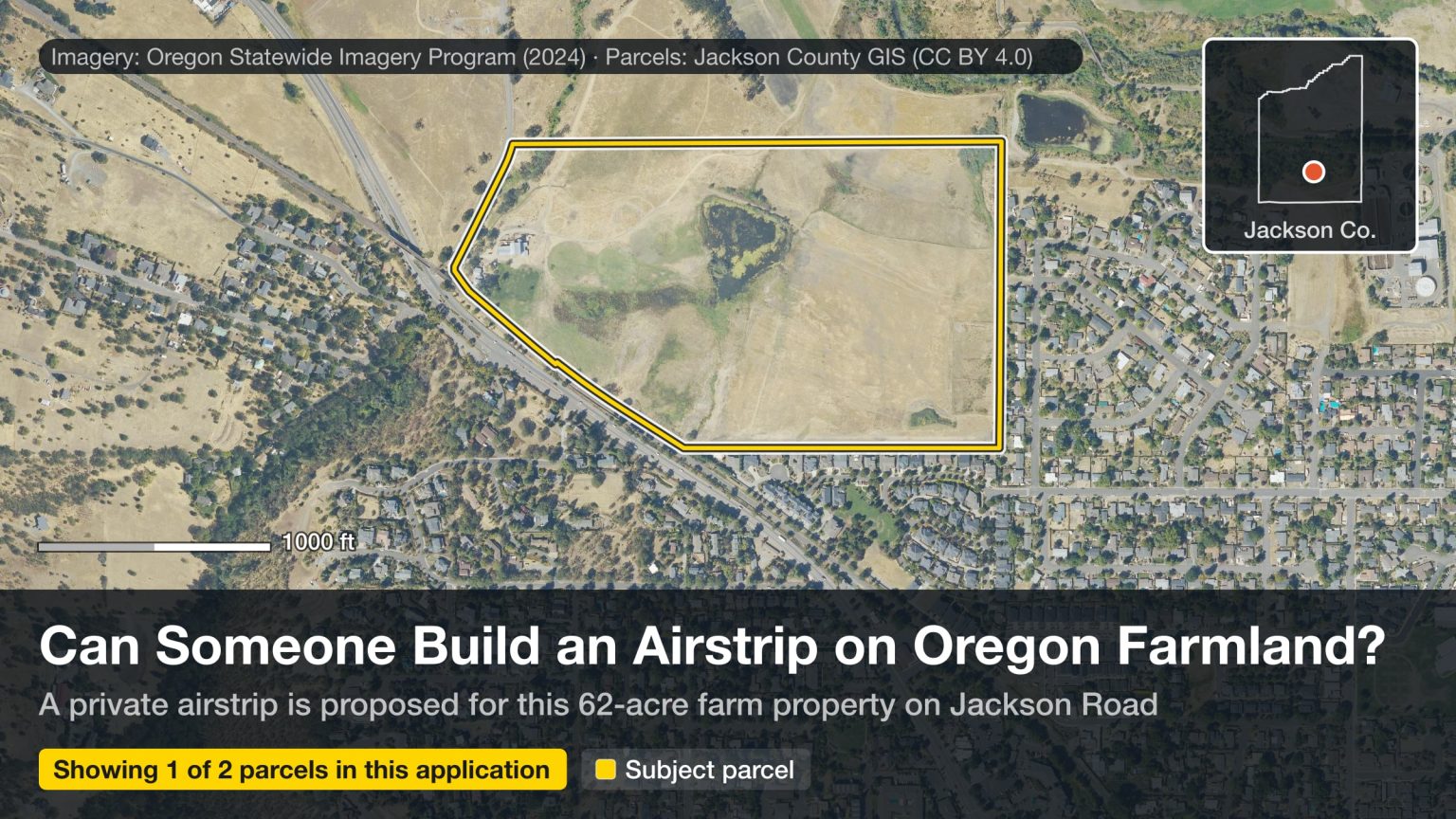
A landowner on Jackson Road, at the edge of Ashland, wants to put a grass airstrip in a pasture. It would be about 1,000 feet long, on 62 acres zoned for farming, for the owner’s own use. Jackson County is reviewing it now.
A lot of people have asked us the same question: is that even allowed on farm land?
Sometimes, yes. Oregon lets a county approve a private airstrip on farm land. But the county has to find that it won’t hurt the farms around it. And the strip has to stay private.
Here’s how it works.
What the law allows
Oregon protects its farm land with a zone called Exclusive Farm Use, or EFU. Most things that aren’t farming are kept out. Some other uses are allowed outright. A second list can come in only after county review and a farm test. A “personal-use airport” is on that second list.
The law is strict about what “personal-use” means:
- The owner can use the strip.
- Invited guests can use it, but only now and then. The law says “infrequent and occasional.”
- Commercial flying is allowed only if it’s for farming, like crop spraying.
- No plane can be kept there unless the strip’s owner owns or controls it.
- Emergency landings are always allowed.
Only the Oregon Department of Aviation can make exceptions, and only in specific cases. Strips that were already legal on September 13, 1975 get to stay.
The strip doesn’t have to serve the farm. The owner can fly for personal reasons, including trips for their own business. What it can’t do is serve paying passengers, run flight lessons, or house other people’s planes.
The farm test
This is the part that matters most. A county can approve an airstrip on farm land only if it finds the airstrip won’t:
- force a big change in how the farms around it work, or
- make farming on those farms cost a lot more.
The law’s word is “significant.” If the strip can’t pass that test, the county can’t approve it. If it can pass only with limits, the limits have to be “clear and objective.” That means rules you can check, like a number of flights or the hours of the day. “Fly considerately” doesn’t count.
State rules spell out how the county has to run the test. It has to name the farms nearby and describe what each one does. It has to look at how the airstrip affects each of those practices. Then it has to look at all the effects together.
The rules list examples of harm to look for: traffic, water supply, weeds or pests, damage to crops or livestock, litter, trespass, lower crop yields, and flooding. They also say the county can’t put conditions on a neighbor’s land, or make a neighbor take money to put up with the harm.
So the people who know whether a strip passes are the farmers next door.
The FAA and the state aviation department don’t decide this
Airstrip applications usually come with letters from aviation agencies. Those letters are easy to misread.
The FAA does an airspace review. It checks whether the strip would be safe for planes in the air and for people on the ground. It doesn’t look at land use. Federal rules say FAA airspace determinations are “only advisory” and “will not consider environmental or land use compatibility impacts.”
The Jackson Road file has an FAA letter from December 2024. It says it “does not constitute FAA approval or disapproval of the physical development involved in the proposal.”
The Oregon Department of Aviation does a safety review too. It issues a provisional approval first and sends it to the county. Final approval comes later. In 2021 it gave the Jackson Road strip a provisional approval with limits: daytime and good weather only, owner use only, land in one direction and take off in the other. It also recommended not flying over neighbors’ homes. Its letter says the approval is only about safety, and “in no way preempts or waives any ordinance, regulation or law of any other governmental body.”
The land use decision belongs to the county. That’s been settled for a long time. In 1983 the state’s Land Use Board of Appeals said the county makes the call, and it can set tougher limits than the aviation agency did.
What the courts have said
Berto v. Jackson County (1997). Jackson County turned down an airstrip that would mostly serve a pilot’s paying customers. The Land Use Board of Appeals agreed. “Use by the owner” means use by the owner, for the owner.
Gould v. Deschutes County (2022). The Oregon Court of Appeals said the planes kept at a personal-use strip have to be owned or controlled by whoever holds title to the strip. In that case the land and the planes belonged to different companies, with one trust behind all of them. The court said the planes weren’t “owned” by the strip’s owner. It sent the question of “control” back for another look.
Kennedy v. Klamath County (1983). The county, not the aviation agency, makes the land use decision. It can approve a strip with stricter conditions than the aviation agency set.
How it works in Jackson County
In Jackson County, a personal-use airstrip on farm land is a “Type 3” decision. County staff decide it. There’s no hearing unless someone asks for one, or the county sends it to a hearing on its own.
- The county mails notice of the application to nearby owners and gives people 14 days to send written comments.
- Staff write a tentative decision. The county mails it to property owners within 750 feet, to everyone who commented, and to anyone who asked in writing to be told.
- From the day that notice is mailed, there are 12 days to ask for a hearing. The fee is $250. You get it back if you win. Recognized neighborhood groups whose area includes the site don’t pay it.
- If nobody asks, the decision is final on the 13th day after mailing.
- If someone asks, a county hearings officer holds a new hearing from scratch. People can bring new evidence and raise new issues.
That hearing matters. If the case ever goes to the state Land Use Board of Appeals, the board can only look at issues people raised at the county. And someone who was mailed the staff decision can’t skip the county hearing and go straight to the state board. Raise it at the county or lose it.
What a farm neighbor can tell the county
If you farm near a proposed airstrip, what you know is the evidence. Be specific:
- What you grow or raise, and where it sits compared to the strip and the flight path.
- What a low plane does to your animals or your work, and when it would hit hardest: calving, haying, spraying, irrigating.
- What it would cost you to work around it.
- Anything you’ve seen yourself, with dates.
- What you want: a denial, or limits the county can count.
Ask in writing to be mailed the decision, so you don’t miss the 12 days.
Approval isn’t the end of it, either. If the county sets conditions and they get broken, a nearby farmer who’s harmed can file a complaint with the county. Repeat violations can lead to fines, and then to the use being suspended.
Where Jackson Road stands
The comment window closed October 22. Rogue Advocates filed a comment on October 15. We didn’t ask the county to say no. We asked it to write the state aviation department’s 2021 limits into the permit, along with a cap that matches the owner’s own estimate of about one day a week.
Next comes the tentative decision, unless the county sends the case straight to a hearing. When the county mails the decision, the 12-day clock starts. We asked to be on the notice list, and the county said it would add us. We’ll post what it says. You can follow the case on our Policy & Practice page.
Sources
- What a personal-use airport is, and that it’s allowed on EFU land after review: ORS 215.283(2)(h); OAR 660-033-0120 and 660-033-0130(7)
- The farm test, and “clear and objective” conditions: ORS 215.296(1)–(2); how to run it, examples of harm, no conditions on neighbors: OAR 660-033-0130(5)
- Complaints when conditions are broken: ORS 215.296(3)–(7)
- FAA determinations are advisory and don’t consider land use: 14 CFR 157.7(a); FAA: building a private-use facility
- State aviation site approval, provisional then final: OAR 738-020-0025
- Cases: Berto v. Jackson County, LUBA No. 97-130 (Nov. 21, 1997), opinion; Gould v. Deschutes County, Or. Ct. App. No. A178915 (Oct. 12, 2022); Kennedy v. Klamath County, LUBA No. 83-011 (June 6, 1983), opinion
- Jackson County’s rules: LDO Chapter 4 (Table 4.2-1, 4.2.3, 4.2.9(A)); LDO Chapter 2 (2.7.3, 2.7.5); 2026-27 fee schedule; fee cap and refund: ORS 215.416(11)(b)
- Raise it or lose it: ORS 197.797(1) and 197.835(3)
- The Jackson Road application: Jackson County file 439-26-01734-ZON, including the application narrative, the Oregon Department of Aviation’s provisional site approval (Sept. 20, 2021), the FAA airspace determination (Dec. 11, 2024), and the county’s Notice of Acceptance of Application (Oct. 8, 2026). County file
Related Stories

NEWS – Happenings in Rogue Valley and Statewide (August 2024)
With a few breakthrough projects this year and changes behind the scenes at Rogue Advocates we have quite a lot to tell you! We thank all of you who contributed generous donations, both in time and monetarily, that have allowed us to see so much done halfway through the year in Jackson and Josephine Counties. […]

Rogue Advocates Newsletter – September 2023
Happenings in Rogue Valley and Statewide It has been a busy year for us here at Rogue Advocates! Thanks to your continuing donations and support we have been able to successfully participate in multiple land use applications. Oregon Farm & Forest Lands came under threat by multiple legislative bills and commercial developments over the last […]
Mail Tribune: Rogue Advocates publishes land-use guide for the public
Mail Tribune, November 28, 2022 –– A local land-use watchdog group has published a guide aimed at making Oregon’s often complicated land-use system easier to understand. If more people understand the state’s land-use rules — which involve urban growth boundaries and a host of laws intended to preserve the state’s farm and forest lands — […]